
Daily Habits
The Architecture of a Sustainable Morning Routine
A considered look at how small, repeatable actions in the first hour shape the rest of the working day.

A great deal of writing about men's fitness is, in practice, writing about programmes. Seven-week schedules. Progressive overload tables. Volume periodisation. These are useful frameworks, but they carry an implicit assumption that may not hold for everyone: that the primary barrier is knowledge rather than integration.
For men in their thirties and forties with established professional and domestic lives, the fitness problem is rarely one of not knowing what to do. It is one of finding a way to do it consistently within a life that does not reorganise itself around training. The gym at 6am requires a particular kind of daily logistics — early bed, prepared kit, reliable access — that is achievable for some and not for others, and this variability in life structure is rarely acknowledged in mainstream fitness writing.
Outdoor fitness offers a different kind of integration. A park is always open. A walk that becomes a run that becomes a circuit session requires no membership, no booking, and no fixed appointment. The cost of entry is low enough that the barrier to resuming, after a period of inactivity, is nearly trivial. This low resumption cost is, in practice, one of the most important qualities a movement habit can have.
The outdoor environment also provides something the gym reliably does not: variation. Uneven terrain, ambient weather conditions, and the simple variability of a route walked or run at different times of day place different demands on the body than the controlled environment of an indoor facility. Research in outdoor exercise consistently notes higher reported engagement and lower perceived effort at equivalent intensity levels, compared with matched indoor sessions.
The idea that meaningful strength training requires a barbell and a squat rack is partly a product of how fitness culture developed in the twentieth century, and partly a reflection of genuine biomechanical efficiency. Barbells and machines do allow for precise progressive loading in ways that bodyweight and outdoor movement do not easily replicate. This is not a small limitation, particularly for men with specific body composition goals that depend on progressive overload.
That said, the range of strength adaptation achievable through bodyweight movement, calisthenics, and resistance-band work is broader than popular discourse tends to acknowledge. A well-structured programme combining push variations (press-ups with feet elevated, ring push-ups if access is available, weighted vest if load is desired), pull variations (chin-up bars are widely available in public parks across Belgian cities), hinge patterns (single-leg Romanian deadlift with minimal load), and vertical compression (box step-ups, Bulgarian split squats) can produce substantial neuromuscular adaptation and meaningful changes in body composition over a six-to-twelve month period.
Fitness goals pursued through outdoor movement do require some adjustment of expectation: peak hypertrophy will be slower, and certain movements cannot be replicated without equipment. But for the majority of men whose actual objective is to be strong, lean, and energetic rather than to compete, outdoor training is a fully viable alternative to gym-based work — and, for many, a more sustainable one.
"The low resumption cost of outdoor training is, in practice, one of the most important qualities a movement habit can have."
There is a useful distinction between weekday movement and weekend adventures. Weekday sessions, by necessity, tend to be contained: thirty to fifty minutes, low logistical complexity, close to home or on the way to somewhere. The weekend offers a different quality of engagement — longer, less structured, and more likely to involve nature at scale.
Belgium, despite its relatively compact geography and flat topography, offers substantial outdoor movement options that remain underused by urban residents. The Ardennes offer serious hiking terrain, with routes that challenge endurance and navigation in ways that flat urban parks do not. The coastal dunes between De Panne and Knokke provide an entirely different kind of outdoor movement environment — soft-surface running at varying elevation, wind resistance, and access to long, uninterrupted stretches.
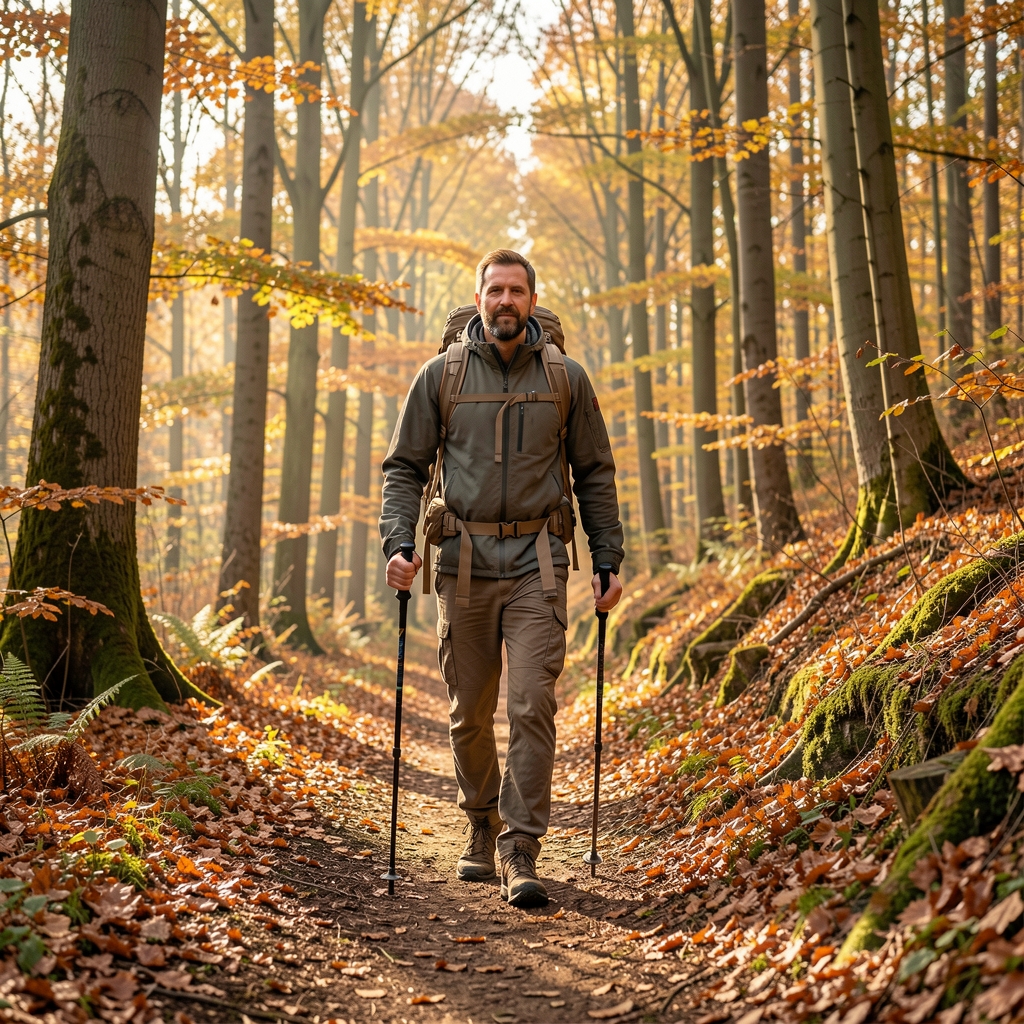
Even within Brussels itself, the Forêt de Soignes — a beech forest of considerable size on the southern edge of the capital — provides trail running, mountain biking, and walking routes that bear no resemblance to the urban environment surrounding them. A Saturday morning in the Forêt de Soignes represents a qualitatively different kind of active recovery than a treadmill session, even if the physiological demand is similar.
The relationship between physical movement and stress management is one of the better-supported findings in contemporary behavioural science. Aerobic exercise in particular has been shown, across a substantial body of independent research, to reduce the circadian markers of prolonged stress exposure — including elevated cortisol profiles, disrupted sleep architecture, and lowered cognitive flexibility.
What is less often discussed is the specific role that outdoor movement plays in this process, beyond the general benefits of aerobic exercise. Studies comparing matched exercise sessions conducted indoors and outdoors — in environments with natural light, vegetation, and ambient sound — consistently find lower self-reported stress and anxiety following outdoor sessions, even at equivalent physiological intensity. The mechanism is not fully established, but the effect is robust enough to be worth noting.
For men managing the intersection of professional demand and personal life — the specific texture of stress that characterises an active career in its middle decades — outdoor movement offers something beyond cardiovascular conditioning. It offers a change of visual and sensory environment that the built interior rarely provides. A run through a park is not the same as a run on a treadmill, even when the pace, duration, and physiological output are identical.
The distinction between a practice and a programme is not merely semantic. A programme has a defined end state, a fixed duration, and a clear compliance framework. A practice is ongoing, self-renewing, and inherently forgiving of variation. Most men who maintain a consistent movement habit over years do so not because they followed a programme to completion but because they built a practice — a relationship with movement that accommodates disruption without terminating.
Building this kind of practice begins with identifying a minimum unit of movement — something brief enough to be done in almost any circumstance, and outdoors by preference. A twenty-minute circuit in the nearest park. A walk of three kilometres at lunchtime. This minimum unit is not the ideal session; it is the anchor session, the thing that keeps the practice alive when the ideal is not available.
Around this anchor, the practice grows gradually — longer sessions at weekends, more structured strength work as habits solidify, seasonal variation that shifts emphasis between endurance and bodyweight strength work in autumn and winter versus trail running and cycling in spring. The result, over time, is not a completed programme but an ongoing engagement with physical activity that changes shape across the year while remaining consistently present.

Tobias Ashcroft is a staff writer at Granelis Journal, covering the intersection of daily habit, personal care, and active living. His writing draws on behavioural research and practical observation gathered across seven years of editorial work in wellness publishing.
More from this author →
A considered look at how small, repeatable actions in the first hour shape the rest of the working day.
A practical overview of batch cooking strategies that hold nutritional quality across four days.