
Daily Habits
The Architecture of a Sustainable Morning Routine
A considered look at how small, repeatable actions in the first hour shape the rest of the working day.

The nutrition habits that sustain an active life tend to share a quality that is rarely the subject of dedicated articles: they are prepared in advance. Not lavishly, not elaborately — but with enough forward-looking attention that the decision about what to eat on a Wednesday afternoon is already settled by Sunday evening.
The case for adequate protein in men's nutrition is well-established in independent nutritional research, and has grown considerably more nuanced in recent years. The older framing — protein is for muscle-building — has given way to a broader understanding of protein's role in satiety, cognitive function, and metabolic stability across the day. Protein contributes to normal energy production, supports the maintenance of muscle mass during periods of caloric reduction, and contributes to normal function of the immune system in ways that are not shared by equivalent caloric contributions from carbohydrates or fats.
For men engaged in regular strength training or outdoor fitness — even at moderate intensity — the general guidance from nutritional research suggests a daily intake in the range of 1.6 to 2.2 grams per kilogram of body weight. A man of 80 kilograms pursuing a moderately active lifestyle would, under this framework, benefit from between 128 and 176 grams of protein daily. This is more than most working men consume on an ad hoc basis, and the gap tends to widen during the working week, when time constraints push meals toward convenience options that are typically carbohydrate-heavy and protein-light.
This is where meal preparation becomes practical rather than aspirational. The deficit is not a matter of motivation or discipline in the moment — it is a matter of what is available when a decision needs to be made quickly. A prepared meal is not a willpower exercise; it is simply the better option made more accessible.
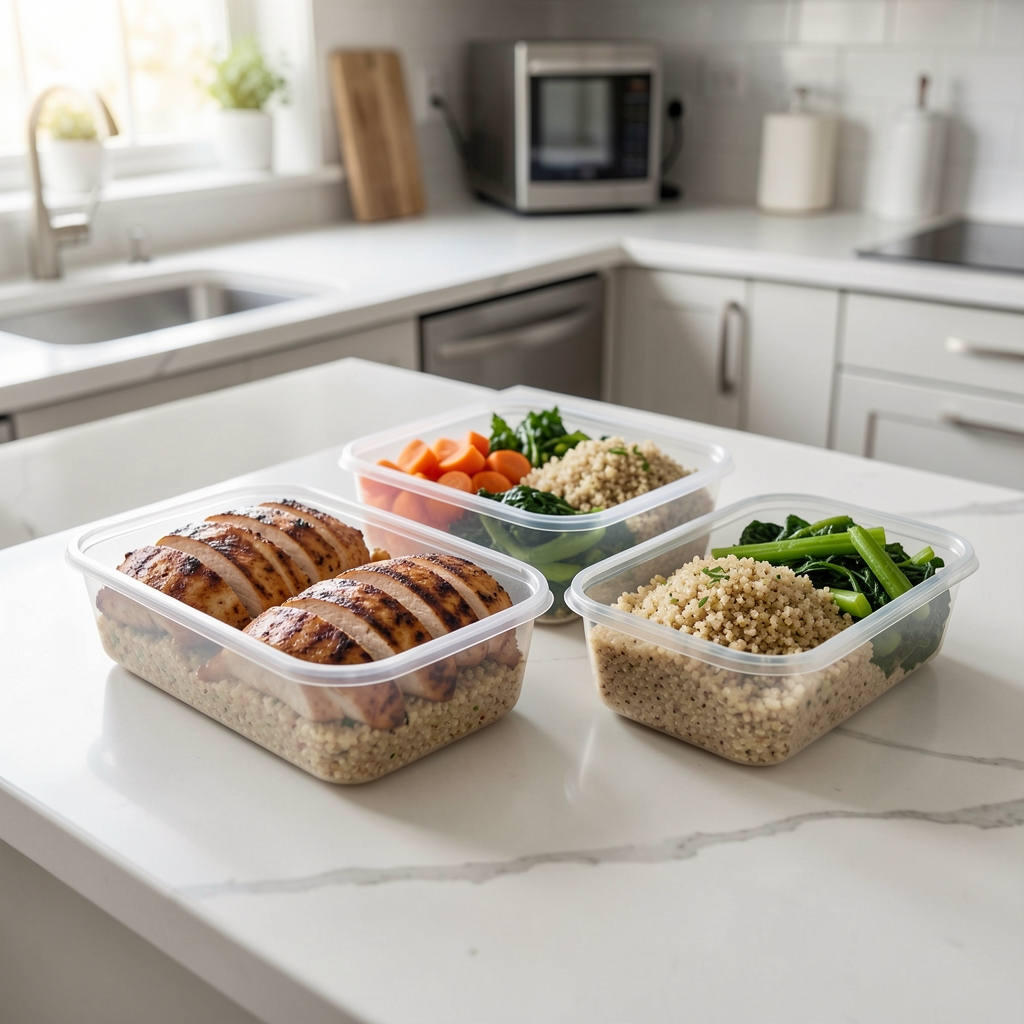
The practical unit of meal preparation for most working men is a two-hour session on a Sunday afternoon that prepares the protein components for Monday through Thursday. Friday is left deliberately open — it typically involves a more social eating context, and the prepared containers are usually depleted by Thursday evening in any case.
The core of this session is the simultaneous preparation of two or three protein sources that can be combined across different meals without becoming repetitive. A batch of roasted chicken thighs (six to eight pieces, seasoned simply and roasted at 200 degrees for thirty-five minutes) provides the backbone. Alongside this: a portion of tinned or freshly cooked pulses — chickpeas, lentils, or white beans — that can serve as a complete protein source at breakfast or as a lunch component. A batch of hard-boiled eggs, six to eight, prepared in advance and refrigerated, complete the protein portfolio.
These three sources together — chicken, pulses, eggs — cover the protein requirements for four days of lunches and several breakfasts without monotony, and without any further cooking on the day. The Sunday session also typically includes the preparation of a grain base (brown rice, farro, or quinoa, cooked in large batch) and two or three roasted vegetable portions that serve as the supporting structure for assembled meals.
"A prepared meal is not a willpower exercise; it is simply the better option made more accessible."
If one meal carries disproportionate weight in the context of whole-week nutrition, it is breakfast. The pattern observed in men who consistently hit adequate protein intake is almost universally one of a substantial breakfast — thirty to forty grams of protein in the morning meal — rather than a distribution that relies on dinner to compensate for a protein-light earlier day.
The prepared components make this straightforward. Two hard-boiled eggs (twelve to fourteen grams of protein), a portion of Greek yoghurt (fifteen to twenty grams in a 200g serving of full-fat Greek yoghurt), and a tablespoon of seeds or nuts in a small bowl constitutes a breakfast that delivers between twenty-eight and thirty-five grams of protein with approximately five minutes of assembly. The yoghurt and eggs were prepared in advance; the assembly requires no cooking.
The alternative — overnight oats with protein additions — suits men who prefer a gentler breakfast texture. Whole rolled oats (fifty grams) soaked overnight in milk or a plant-based alternative, with two tablespoons of natural nut butter stirred in and a scoop of unflavoured protein powder if desired, provides a similar protein quantity with a different sensory profile. The preparation takes three minutes the evening before, and no morning cooking.
| Component | Approx. Protein | Prep Method |
|---|---|---|
| Chicken thigh (100g cooked) | 27g | Batch roasted Sunday |
| Cooked chickpeas (100g) | 8g | Tinned or pre-cooked |
| Hard-boiled egg (large) | 7g | Batch cooked, refrigerated |
| Greek yoghurt (200g) | 18g | Ready to use |
| Salmon fillet (120g) | 28g | Pan-cooked fresh, 12 min |
| Lentils, cooked (150g) | 13g | Batch cooked Sunday |
The working lunch, when assembled from prepared components, takes four to six minutes. The grain base goes into a container; two or three spoonfuls of roasted vegetables alongside; a portion of chicken or lentils on top; a drizzle of olive oil and a squeeze of lemon; a small handful of fresh leaves if available. The result is a balanced plate with adequate protein, complex carbohydrates, and a range of micronutrients. It requires no decision-making in the moment, and no cooking.
The variation across the week comes from rotating the protein source — chicken on Monday and Tuesday, lentils on Wednesday, eggs in a different configuration on Thursday. The grain base can also rotate: brown rice on Monday and Tuesday, farro for Wednesday and Thursday. This rotation prevents the monotony that terminates most meal preparation habits within two or three weeks.
One element that sustains the habit longer than any other is the quality of the containers. Glass containers with airtight lids maintain food quality noticeably better than most plastic alternatives, and their weight is offset by the ease with which they can be reheated without transferring content. This is a small detail with a disproportionate effect on the durability of the habit.
Belgium's culinary infrastructure offers unusual advantages for lean eating and whole-food preparation. The presence of regular local markets in most Brussels neighbourhoods — the Marché du Midi on Sundays, the Marché de la Bascule on Saturdays in Saint-Gilles, the smaller daily market near Place du Luxembourg — provides access to fresh, seasonal produce at competitive prices. For men interested in meal preparation, the Sunday morning market trip and the Sunday afternoon cooking session pair naturally.
Spring in Belgium brings broad beans, asparagus, and the early leeks that disappear quickly from market stalls; summer offers courgettes, tomatoes, and fresh legumes; autumn shifts toward root vegetables, chicory, and the brassicas that are among the most nutritionally dense additions to any meal. Building the weekly meal preparation around seasonal vegetables is not merely an aesthetic preference — it is a practical strategy that ensures variety across the year while keeping ingredient costs modest.
The protein sources tend to vary less with the season, though spring and summer invite lighter preparations — cold grain salads with smoked fish, bean and herb combinations that need no heating — while autumn and winter favour warmer formats: roasted trays, slow-cooked lentil dishes, egg-based preparations that work at room temperature or reheated. The discipline of the practice stays constant; the expression of it changes with the calendar.

Eleanor Whitfield is a guest contributor at Granelis Journal with a background in nutritional communications and food writing. Her work focuses on practical eating strategies for active adults in urban environments.
Read another article →
A considered look at how small, repeatable actions in the first hour shape the rest of the working day.
Notes on integrating natural movement into an urban schedule without rigid structure.